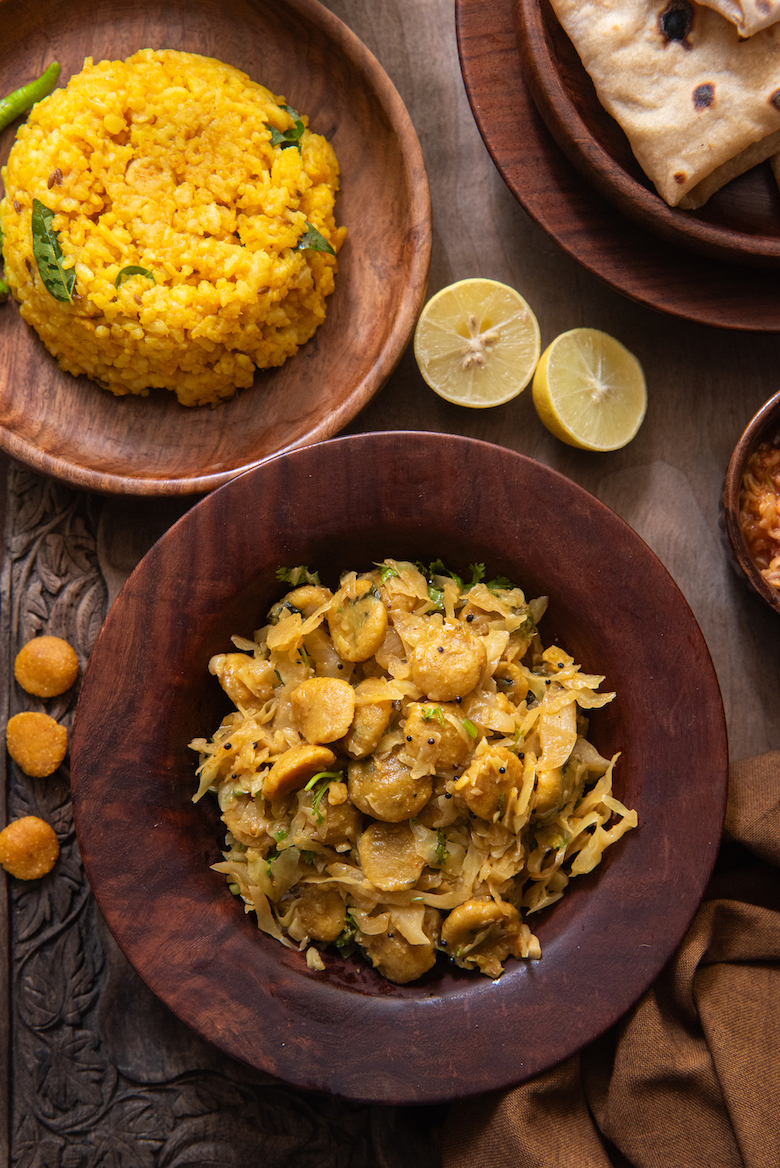
I’ll be honest, I hadn’t expected to find dhokli in a kobich (cabbage) shaak. Who adds dhokli to a vegetable that usually requires no add-ons or the is the one that cooks rather quickly? How do you balance the cooking times? Wouldn’t the spices overpower the gentle flavour of cabbage? My mind was full of such questions when I decided to attempt this shaak I had found in a cookbook more than seventy years old.
In this version, the dhokli is made using rawo (wheat semolina) and besan. The combination gives it a nutty, coarse (farsu) texture, and with the addition of methi, it carries just the right balance of flavours—a little bit of everything.
Today, we take the ready availability of vegetables for granted. But this was not always the case when our cuisines were evolving. Crop failures were common, food was scarce, and not every household had easy access to abundant produce. Families were large, and people found ingenious ways to stretch the meagre vegetables harvested from their land—if they owned any at all. This, perhaps, is one of the reasons seasonal vegetables were paired with flour dumplings we now call dhokli.
These days, of course, potatoes seem to have quietly replaced dhoklis! Over the years, the many kinds of dhokli recipes I have discovered across Gujarat have made me draw this parallel: if dhokli were a person, it would be the most accommodating, unassuming soul—someone capable of winning over any crowd through humility, simplicity, and adaptability alone.
It is preparations like these that make us marvel at the vast repertoire of recipes we have inherited—treasures we too often overlook or take for granted.
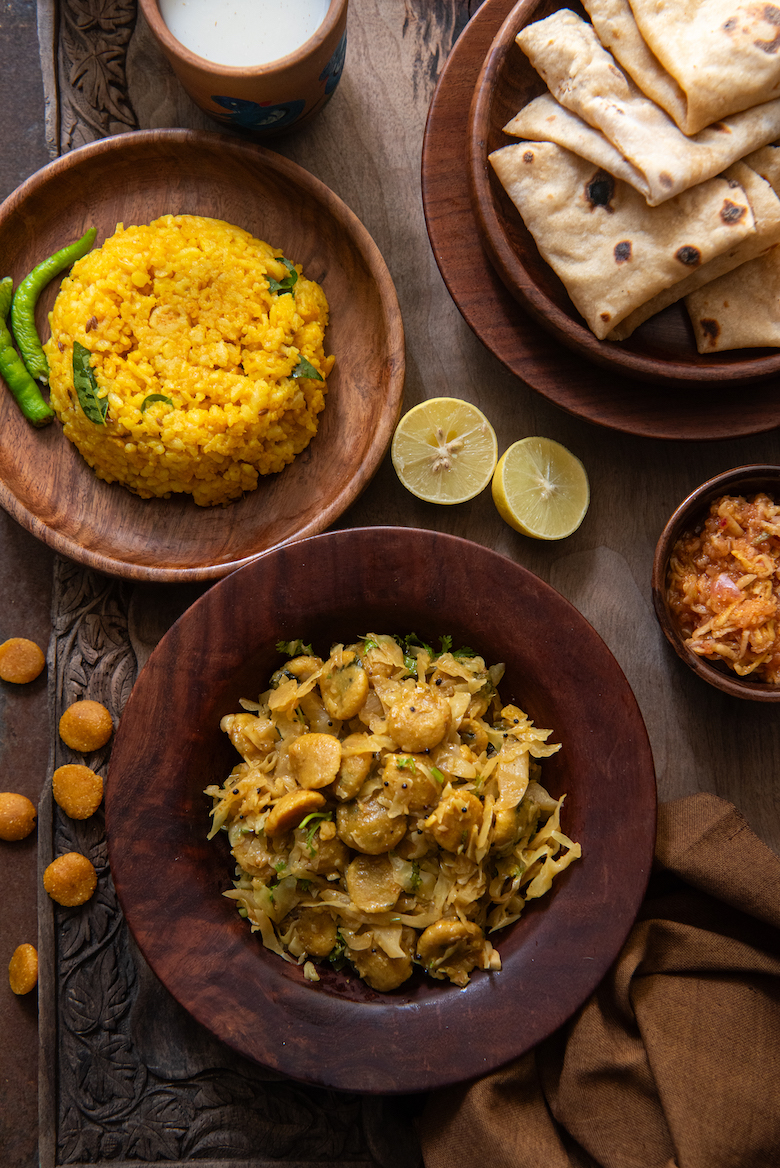
Kobich na shaak ma rawa ni dhokli
Ingredients
Equipment
Method
- To make the Dhokli In a mixing bowl, combine all the ingredients listed under Dhokli, except the oil. Mix the dry ingredients thoroughly, then add the oil and rub it in. Gradually pour in water and knead into a semi-stiff dough. Continue kneading until the surface is smooth. Cover the dough and let it rest for 15–20 minutes.
- Once rested, pinch off portions the size of a large pea. Roll them into small balls and flatten each into a thin disc—these are the dhoklis. Keep them covered while you prepare the cabbage subzi.
- To make Kobich Shaak Heat oil in a large kadai. When hot, add the mustard seeds. Once they begin to splutter, add the sliced green chilies and sauté for a minute. Quickly add asafoetida and turmeric powder, followed by the shredded cabbage. Season with salt, stir well, cover, and cook over a gentle flame. When the cabbage is partly cooked, sprinkle in the coriander and cumin seed powder.
- Cook for a few more minutes, then add the prepared dhoklis along with a tablespoon of oil and ¼ cup of warm water. Cover the kadai with a lid that can hold some water, and pour a little warm water over it—the condensation will help the dhoklis cook without turning mushy. Avoid stirring too often, as the dhoklis may break.
- The dhoklis are done once they swell and change color. At this stage, stir in a little sugar and lemon juice, cook briefly, and turn off the flame.
- Serve hot with rotli, alongside chaash and kachumbar.