In Gujarati cuisine, dhoklis are truly bahuroopi, and yes, I would like to call them that, for their unassuming ability to transform themselves to suit the community, region, season, and circumstance. Amazing, right?
In one of my earliest blog posts, I shared childhood memories of my Nanima assigning us the task of shaping dhoklis in whichever ways we pleased. The dhokli dough became our playdough as we pinched, folded, pressed, knotted, and braided it into whimsical forms. Each of us in the bachaa party fashioned dhoklis according to our imagination.
When the entire family of nearly thirty gathered during summer vacations, cooking elaborate meals on time was no easy feat. But with these dhoklis, Ba had a clever strategy: not only did they keep her thirteen grandchildren occupied, they also helped the meal come together quickly and gave the kitchen helpers a bit of respite. The shaped dhoklis were dropped into a simmering stew of whole toor beans we called baakda, and the dish became Baakda-Dhokli. As I continue studying the vivid regional cuisines of Gujarat, it came as a delightful surprise to learn that these playful dhoklis actually have a name: Ramakda Dhokli (toy dhokli).
Once we move beyond the familiar vaneli (rolled) dhokli, a fascinating world unfolds: kachori dhokli, padika (envelope) dhokli, vadi (thick, cake-style) dhokli, khichiya (rice) dhokli, dabeli (pressed) dhokli, shekeli (roasted) dhokli, and the list goes on. It is not just wheat flour that shapes these forms; bajra, jowar, besan, and rice flours all become part of the dhokli repertoire, paired with seasonal vegetables, pulses, and lentils in endlessly adaptive ways.
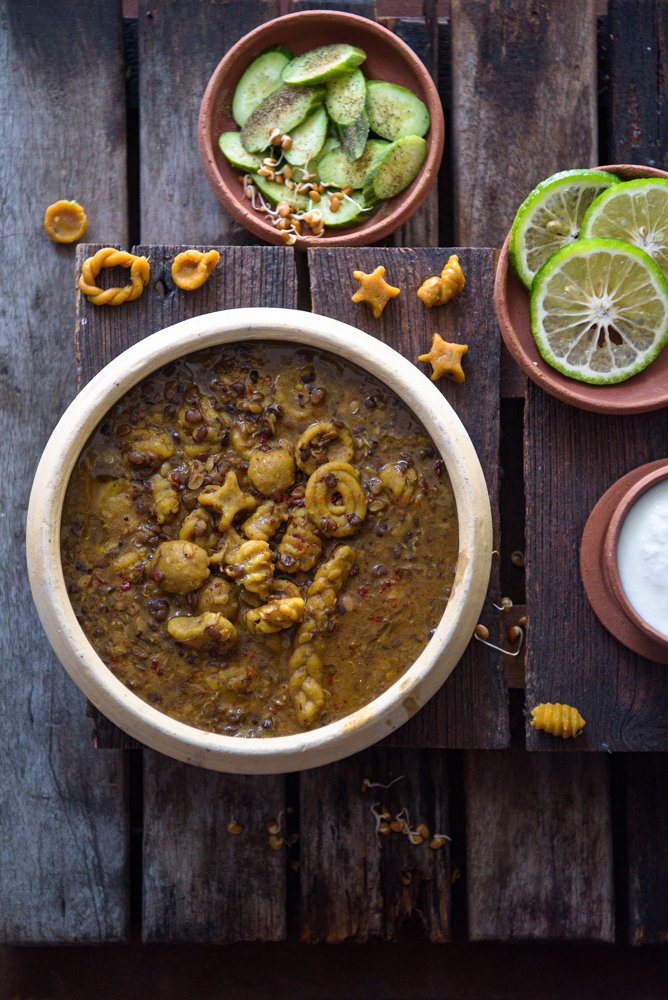
Featured here is Kadthi/Kulith ma Ramakda Dhokli, where both the pulse and the style remain outside mainstream dhokli conversations. Although Gujarat does grow kulith (horse gram), this super pulse has never quite entered everyday cooking in a big way. Yet this comforting bowl meal may persuade you to give it a try.
Kadthi requires patience, as it cooks and breaks down best when slow-cooked. To make the process more practical, I used sprouted kadthi for this meal, pairing it with garlic-flavoured dhoklis and, of course, a generous dollop of ghee.
And tell me, do you carry memories of Ramakda Dhokli too?