
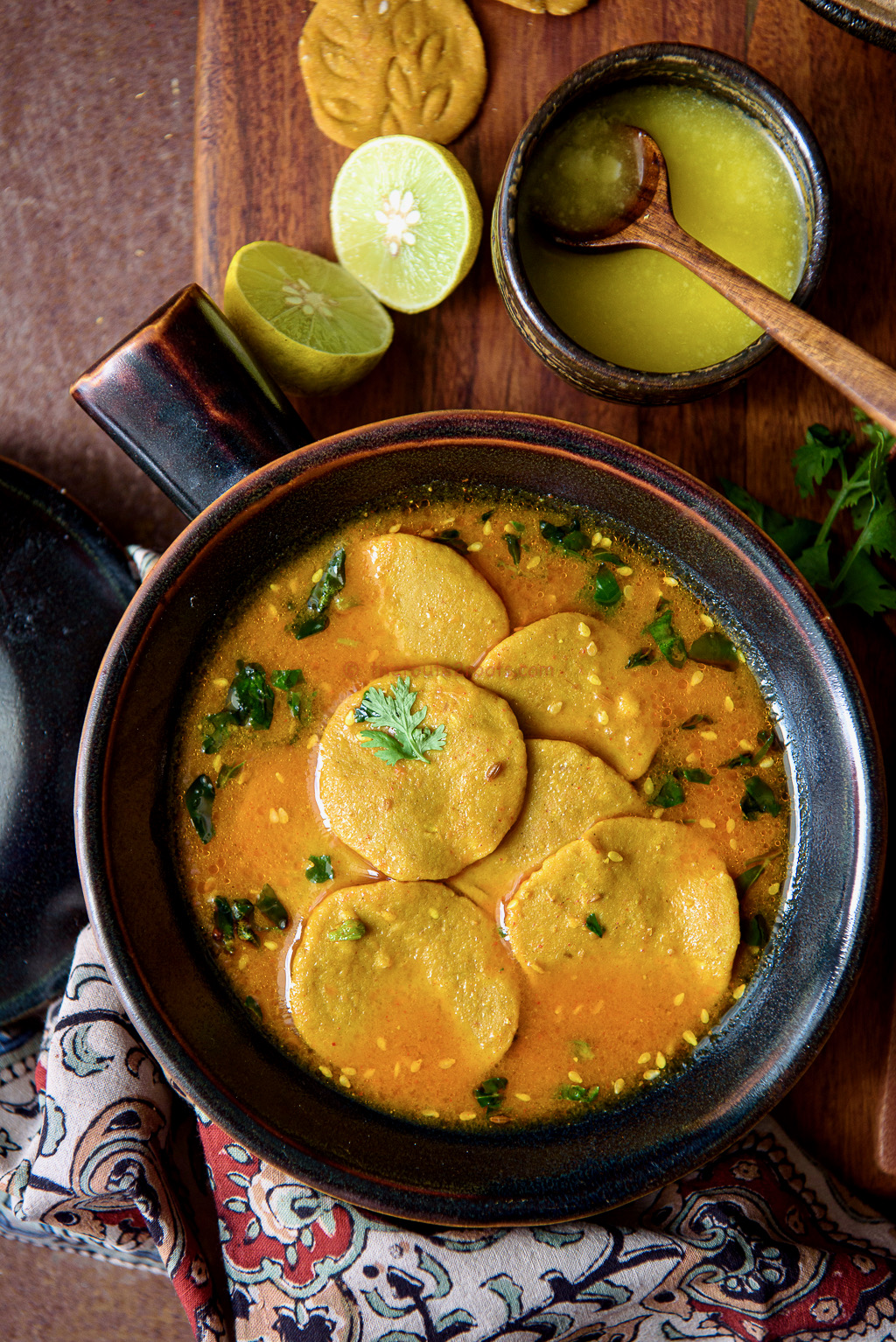
Isn’t food supposed to be like so, frugal yet delicious, cooked with minimum effort and ingredients but maximum on flavour and value? Uchada Pani ni Dhokli, the charm of this name does get lost when transliterated, into Dhokli in boiling broth. However, to those conversant with Gujarati the name sounds like Ba instructing us to when to add Dhokli discs into the broth, Uchadvu means to jump, bounce represents roaring boil here, telling us to add the dhokli discs to the broth that is on a roaring boil. And to allow them to cook on high.
This is another gem of a recipe Pinky Jhaveri shares with theroutetoroots.
“For my family, winter and Bajri/pearl millets go hand in hand. As soon as the temperatures begin to drop after Diwali, this Dhokli makes its appearance on our dinner table 🙂 I have not seen any other families make this version so it must be popular in Mandal (a town near Surendranagar) and surrounding villages. We like it for its simplicity. It needs just a few ingredients and comes together in 30 mins. Almost broth kind of rasa/jhol with Ajwain helps clear any winter sinuses.My Baa always said that bajri, ajmo/ajwain/carrom seeds and hot raso/broth clears all winter sinuses and congestion. The bajri also helps relieve constipation. She used to say “pet sāf aavi jase/clears your tummy,” Pinky’s insights to this unique Dhokli recipe from her part of Gujarat where Bajra rules.
I have never been a fan of Dhokli or for that matter fresh pasta because the idea of chewing into boiled dough never appealed me. Hence, I always maintained a safe distance from all things Dhokli and muthiya (unless they were fried). Also growing up in a household where roti/bhakhri/rotla carried the meal forward, Dhokli never became mainstream for me. Even rice (to complete the meal) was never a must for me. Roti-Subzi was all I needed as a meal. So all these Dhokli recipes I am recreating to share on the blog are making me a Dhokli convert. They are exposing me to the whole genre of Dhokli’s that I and many of us have never been aware of, teaching us how ingenious our forebears have been with food, how they managed to feed their large broods with limited ingredients they had on hand, how they knew the nourishing values of these ingredients and how we as the heirs to such great repository of regional cuisines need to hold on to our inheritance (the least we can do) for the greater good of our health and that of our ecosystem.
The recipe along with informative videos Pinky made in her San Francisco kitchen are on the blog. Ever so grateful for Pinky and her efforts to support me build theroutetoroots repository.
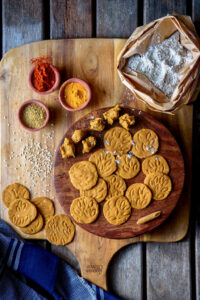
Uchada Pani ni Dhokli
Serves: 3
Ingredients
Method
- In a large bowl, bring all the ingredients of dough together and knead into semi soft dough.
- Let the Dough rest for 10 minutes while you work on the Rasa.
- Once the dough is rested, knead for another minute and shape them into thin logs.
- Cut the log into 10-15g pieces. Press each piece between your palms and shape them into discs.
- Each disc with a diameter of 1.5 inch.
- For the Rasa,
- Heat a kadai. Keep the flame on medium high
- Add the oil.
- When the oil is hot, add mustard seeds, ajwain, hing and Hadi.
- Add chopped methi leaves and cook for a minute.
- Add all the water and let it boil for 4-5 minutes. Add the red chili powder, salt and dhana jeeru. When the water is on a rolling boil, add the Dhokli, few pieces at a time.
- Reduce the flame to medium and cook for 10-15 minutes.
- The cooking time depends on thickness of Dhokli. Thinner Dhokli cooks in about 12-13 mins.
- The water should be reduced to half at this point. If the Dhokli is cooked, switch off the gas and let it rest for two minutes.
- At first Rasa looks thin but it will start to thicken soon.
- Add chopped coriaander and serve the Dhokli warm.
- A drizzle of peanut oil/ghee tastes very good on top!